 Worksheets
Savings goals
Turn “one day” into a savings plan.
Name the goal, choose a target and see the gap. Keep progress visible and work out what your planned contribution would mean over time.
Opens Worksheets Personal. Choose Create account on the next screen.
- Start with your own records
- No live bank connection required
The everyday problem
A wish is hard to measure without a target
Saving for a break, an emergency buffer or a large purchase can feel vague when the only number is the account balance. A target amount and a date make the next step easier to understand. They also let you notice when the planned contribution and the deadline no longer fit together.
A clearer way to manage it
How Worksheets helps
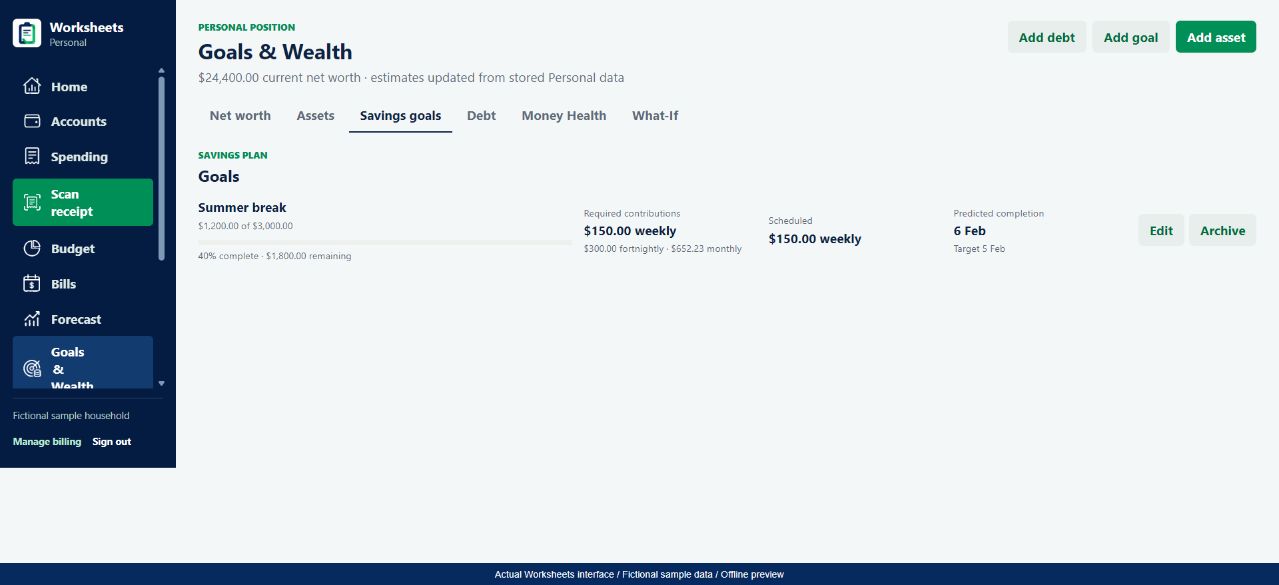
In Goals & Wealth > Savings goals, Worksheets Personal shows the amount saved, target, percentage complete and amount remaining. Adding a target date produces estimated weekly, fortnightly and monthly contributions. A recorded contribution schedule provides a predicted completion date. These are planning calculations, not automatic transfers or promised returns.
- See progress towards a specific goal rather than treating every dollar of savings as unallocated.
- Compare a target date with a contribution you believe you can maintain.
- Review or archive a goal when your priorities change without pretending the savings have moved.
From the app to your everyday routine
Three practical steps
Create a goal that means something to you
Open Goals & Wealth > Add goal. Give it a clear name and enter the target amount and amount already saved. Check that the amount is really available for this purpose.
Add a target date and a contribution plan
Use a realistic deadline and a planned contribution cadence. Read the required contribution separately from the predicted completion date; the app estimates these using different time-period assumptions.
Keep progress honest
Update the saved amount as circumstances change, or use the linked-account balance option when appropriate. Check that the same account balance is not being mentally promised in full to several goals. Revisit the plan when you withdraw savings.
A worked example
A$1,200 saved towards a A$3,000 break
Fictional Australian-dollar figures - not personal financial advice
On 13 November 2026, a fictional household has A$1,200 saved and a A$3,000 target for 5 February 2027, 84 days away. It is 40% complete with A$1,800 remaining. Dividing that gap across 12 weeks gives an estimated A$150 per week, or A$300 per fortnight.
| Goal detail | Fictional value |
|---|---|
| Target | A$3,000 |
| Already saved | A$1,200 |
| Remaining | A$1,800 |
| Required weekly estimate | A$150 |
| Required monthly estimate | A$652.23 |
A$1,200 / A$3,000 = 40% complete
The actual engine estimates completion on 6 February for a recorded A$150 weekly schedule, one day after the target. Its schedule projection uses annualised cadence, while the required contribution uses days to the target. This small difference is a reason to review the plan, not a promise of an exact transfer date. No interest or return is assumed.
Use the numbers thoughtfully
What to keep in mind
A useful tool makes its limits clear. Check the underlying records before making a financial decision.
- Worksheets does not open a savings account, transfer money, ring-fence funds or earn interest for you.
- A contribution schedule is a plan, not evidence a deposit occurred. Keep the current saved amount up to date.
- Required contributions and predicted dates are estimates. They can differ with the timeframe and cadence assumptions and do not guarantee a goal will be reached.
Good questions
Savings goals FAQs
For independent Australian money guidance, visit MoneySmart: how to start saving. This is a helpful resource, not an endorsement of Worksheets.
Does creating a goal move money out of my account?
No. It creates a plan and a progress record. Any real transfer must be arranged separately through your bank or other provider.
Can I choose weekly or fortnightly contributions?
Yes. The goal shows estimated required weekly and fortnightly contributions when a target date is supplied. A contribution schedule can also be recorded for planning.
What if I cannot save the estimated amount?
Review your target date, target amount and other commitments. The app lets you update the goal; it does not decide which personal priorities you should cut.
Why is the predicted finish not exactly my target date?
The required contribution divides the remaining amount by the time to your target. The schedule projection converts your chosen cadence into an annualised pace. Rounding and those different assumptions can produce different dates.
One part of your bigger picture
Keep building your money routine
Explore all Worksheets Personal features or compare plans and pricing.
Worksheets Personal
A clearer picture starts with your next step.
Bring your records together and build a money routine that makes sense to you.
Choose Create account after opening the app.